The New Stadium, In Brief
The Buffalo Bills' new home in Orchard Park opens for the 2026 NFL season, replacing the old stadium directly across the street — less than 500 feet away. It holds roughly 62,000 fixed seats (down from the old stadium's 71,608) in a steeper, stacked, open-air bowl purpose-built for Buffalo football: closer seats, louder crowd, and serious engineering aimed squarely at the weather.
Here's the part that surprises people: fewer seats, but a much bigger building. The new stadium has a footprint of about 1.35 million square feet on a roughly 242-acre site — far larger than the old stadium — even though it seats around 10,000 fewer fans. That extra space went into wider concourses, far more premium and club areas, better sightlines, and modern amenities, rather than into cramming in more seats.
Most seats in the new stadium are tied to a Personal Seat License (PSL) — a one-time license that gives you the right to buy season tickets for that specific seat, year after year. The Bills made 54,628 PSLs available (the rest of the seats are held back for suites/loge, the visiting team, and community use), and every one of them sold out, generating around $260 million. That sellout is exactly why a resale market exists — and why a local broker like PSL Buffalo can connect Western New York buyers and sellers directly.
What Makes the New Stadium Special
This isn't just a bigger version of the old place. A handful of design choices genuinely change the game-day experience — and they're worth knowing whether you're buying a seat or just curious:
Fans are dramatically closer to the field
The whole bowl was redesigned around proximity. Seats are stacked at a steep 34-degree incline, which pulls every row closer to the field and down toward the action instead of back and up. The first rows above the north end zone sit only about a dozen feet above field level — low enough that you're practically looking the players in the eye, creating a wall of noise right on top of them. And because the lower bowl was made more intimate with the decks stacked steeply above it, even the upper deck here is billed as the closest-to-the-field upper deck in the NFL. In practical terms, a 300-level seat in the new building puts you meaningfully nearer the play than the same seat would have in the old stadium, where the field sat 50 feet below ground level and pushed everyone back.
The wind problem, engineered away
The old stadium was infamous for the Lake Erie wind whipping across an open bowl. The new building wraps itself in more than 4,400 perforated steel panels — each punched with the charging-buffalo logo — that diffuse and slow the wind before it reaches the seating bowl. It stays open-air (this is still Buffalo football, not a dome), but the gusts that used to knock field goals sideways and chill the crowd are broken up before they get to you.
A canopy and one of the NFL's largest snow-melt systems
A canopy covers roughly 64% of the seats, shielding fans from snow while trapping crowd noise to make the place punishingly loud for visiting offenses. Built into that canopy is a hydronic snow-melt system — sensors detect snowfall and pump heated water through pipes in the roof to melt it on contact, radiating warmth down toward the seats. There's radiant heat at gathering points throughout the concourses, too.
A real grass field, kept alive through Buffalo winter
The Bills deliberately chose natural grass over artificial turf. Keeping real grass healthy through a Western New York winter takes technology: a SubAir system regulates moisture and air in the soil, underground heating keeps the root zone warm, and UV grow lights give the grass the light it needs to stay playable when the sun won't.
You see the field the moment you walk in
The main concourse is open to the bowl — step through the entrance and the field is right there in front of you, rather than hidden behind a wall of concession stands. The concourses wrap with 360-degree visibility, so you're rarely cut off from the game while grabbing food or heading to your seat.
The Field Club — field level, right at the tunnel
Below the 100 level sits the Field Club, reached by a dramatic staircase and escalator down to field level. It holds up to 1,200 fans whose seats are in the 100 level directly above, and its signature feature is a front-row view of the tunnel the players use to enter and leave the field — so the entire team walks right past you at halftime and after the game. It comes with food, drink, TVs, and a DJ booth.
The bison at Family Circle
Out front, the new "Family Circle" plaza is anchored by three giant stainless-steel American bison — a bull, a cow, and a calf, meant to symbolize family. The bull alone stands about 27 feet tall, stretches 29 feet long, and weighs around 23,000 pounds. Whatever you make of them (Bills fans have had opinions), they're destined to be the city's newest landmark and the obvious meet-up spot before kickoff.
Seating Levels
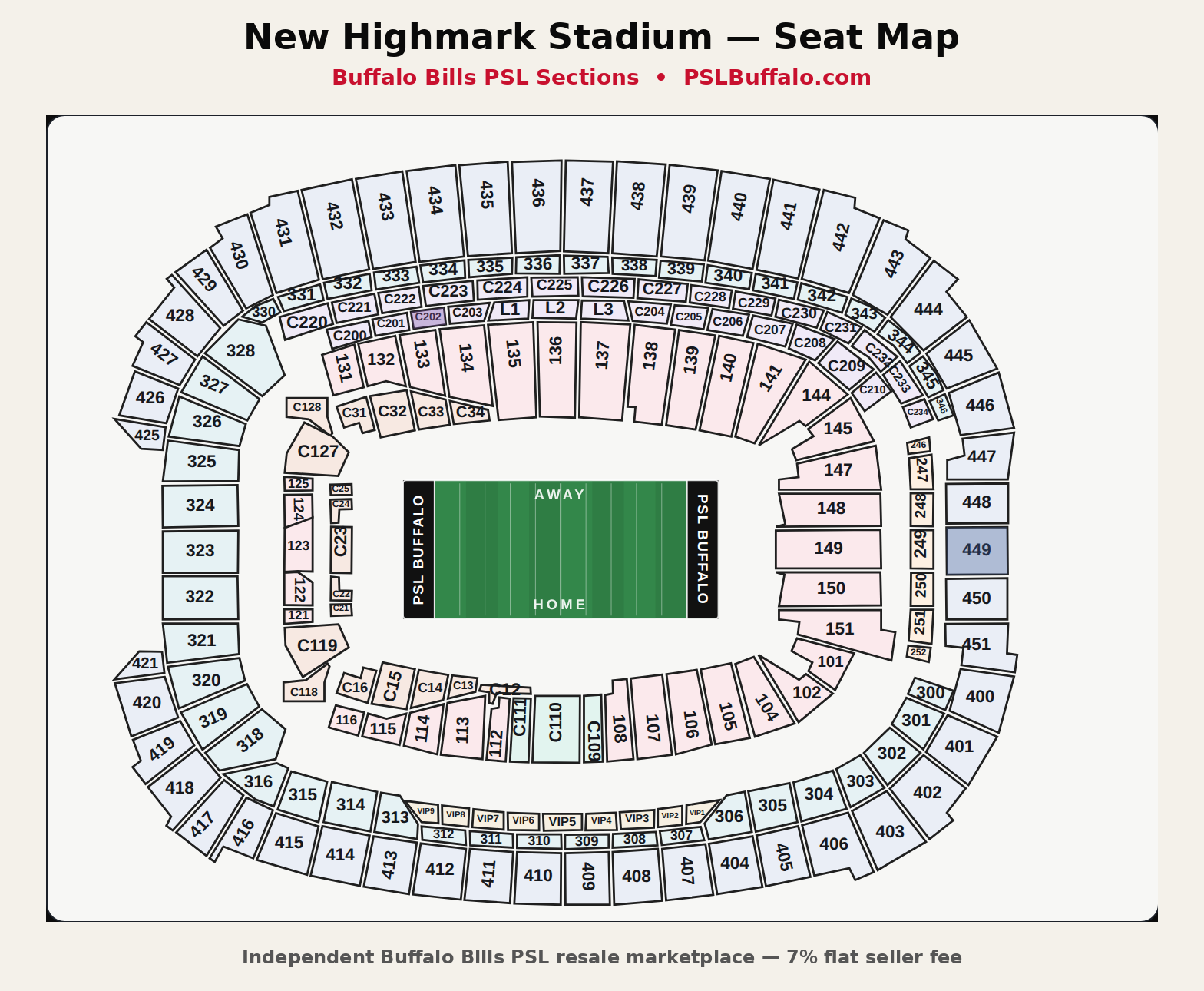
The bowl is organized into four main levels plus the club and premium areas. Here's how to think about them:
Club & Premium Seating
The clubs are where the experience changes from "great seat" to "all-in day out." Based on the official license agreements, club PSLs carry meaningfully more than a standard seat:
East Club
- Access to the climate-controlled East Club space, with wider, cushioned seats
- VIP entry gates for every Bills home game
- One premium-lot parking pass available per five seats
- One post-game field access pass per seat each season (game selected by the team)
- A priority window to buy tickets for concerts and other stadium events
- Food and beverage available for purchase within the club
Founders Club & Field Club
These are the most exclusive tiers in the building, with the closest proximity and the most inclusive amenities. Exact benefits are defined by each club's own license agreement — we confirm the specifics for any given seat before you commit to a purchase.
Parking & Getting There
The stadium sits in Orchard Park, south of Buffalo, in the same area as the old venue. Most fans drive in — the surrounding lots are the heart of the Bills tailgate tradition. Premium-lot parking passes are tied to certain club PSLs (typically one pass per five seats); general parking is bought separately each season. If you're coming from the city, plan for game-day traffic on Route 219 and the local approaches, and give yourself extra time for the new traffic patterns the stadium will introduce.
How PSLs Work — The Short Version
A PSL is not a ticket. It's the right and the obligation to buy season tickets for your specific seat each year, for the life of the license (up to 30 years from the first game at the new stadium). Here's what every buyer should know:
- You still buy season tickets annually. The PSL secures your seat; the season tickets are a separate yearly purchase at the team's price.
- Transfers go through the team's official PSL agent. Every sale needs written consent, a transfer application from both sides, and the agent's transfer fee — that's true no matter who you buy through.
- Balances must be settled first. Many original buyers are on M&T payment plans running through December 2026; a remaining balance or financing must be paid off or assumed before a transfer records.
- Buyers must be eligible. The agreement requires a buyer has never been barred from or removed from a stadium or similar venue, and caps reserved-seat ownership at eight per holder.
That's the part a lot of national sites gloss over. We walk both sides through it in plain English — and your payment is held by a licensed third-party escrow service until the official transfer records.
Browse available Bills PSLs →